
Project overview
- Problem: Codex, Kimi Code, DeepSeek, and OpenCode Go expose quota or account status in separate places. It is hard to see which resource is currently most constrained.
- Approach:
QuotaCorecontains shared models, a parallel coordinator, and four provider probes. TheQuotaBarapplication layer owns the SwiftUI/AppKit menu bar, Keychain, browser-cookie import, settings, and localization. - Result: The menu bar shows the tightest available metric. A provider failure does not block other providers; the last successful value is retained and marked stale.
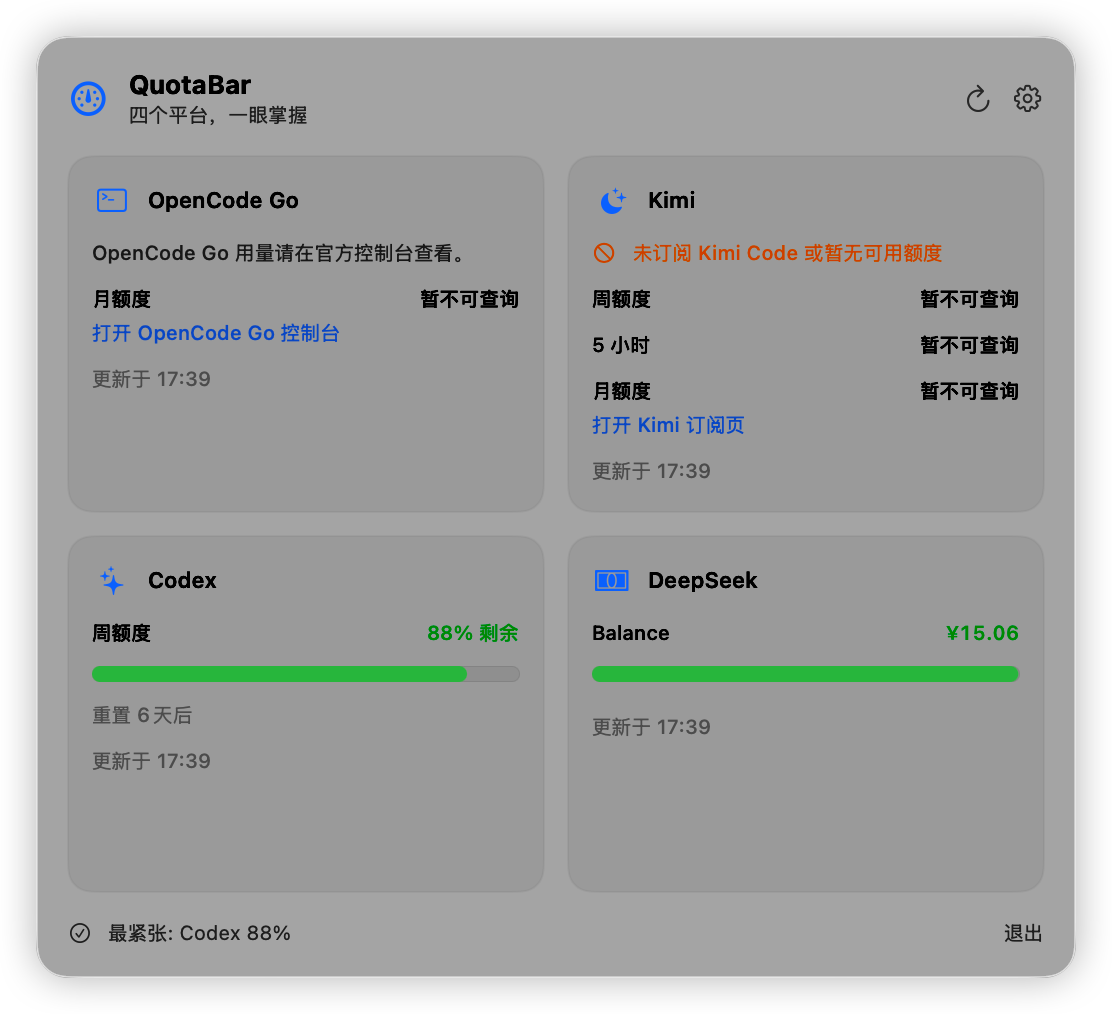
- Current capabilities: Codex weekly quota; Kimi Code five-hour and weekly quotas; DeepSeek CNY/USD balance and account status. OpenCode Go links to the official console and does not claim to query usage inside the app.
- Testing:
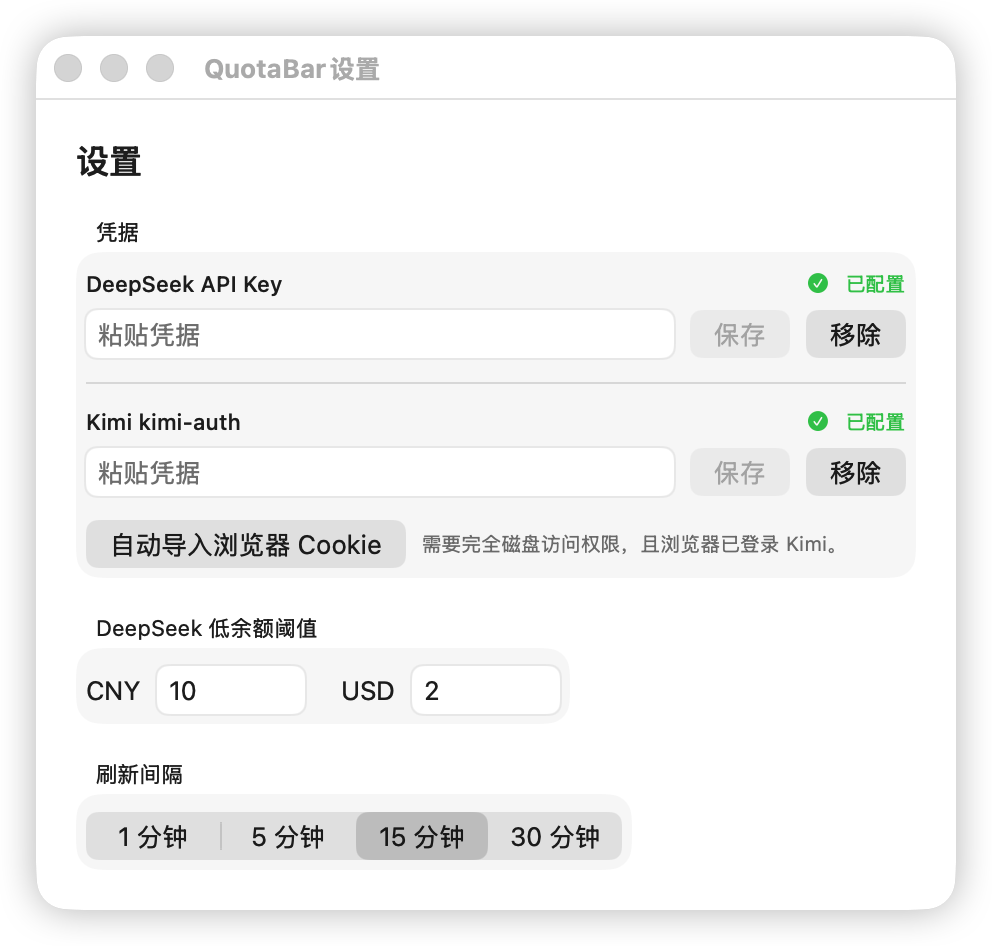
QuotaCoreTestsandQuotaBarTestscover window boundaries, parser fixtures, aggregation, stale data, refresh merging, and progressive card updates. - Privacy: DeepSeek API keys and manually entered Kimi tokens are stored in the system Keychain. The project does not record tokens, cookies, authorization headers, or raw private responses.
- Known limit: Kimi monthly quota has no stable machine interface verified against a real account. The app shows “currently unavailable” and links to the subscription page.
- Release boundary: GitHub currently provides a
v1.0.0-unsigned.1pre-release DMG and ZIP. It is unsigned and not notarized; the site must not describe it as a formal or frictionless installation.
QuotaBar targets macOS 14+ and supports:
- OpenCode Go: use the official console to view subscription usage; no local CLI is required.
- Kimi Code: five-hour and weekly quota; monthly quota currently links to the subscription page.
- Codex: remaining weekly quota.
- DeepSeek: CNY/USD balance and account availability.
The menu bar normalizes available metrics and displays the tightest one. DeepSeek uses configurable thresholds, defaulting to CNY ¥10 and USD $2. A single provider failure never blocks the others; its last successful value remains visible as stale data.
Interface preview
Engineering structure
Sources/QuotaCore: shared models, parallel coordinator, four provider probes, process abstraction, and network abstraction.Sources/QuotaBar: SwiftUI/AppKit menu bar, Keychain, browser-cookie import, settings, and localization.Tests/QuotaCoreTests: window boundaries, parser fixtures, aggregation, and stale-data tests.Tests/QuotaBarTests: refresh merging and progressive card updates.project.yml: XcodeGen project definition.Package.swift: standalone QuotaCore test runner.
Build locally
Requirements: full Xcode, XcodeGen, and macOS 14+.
xcodegen generate
xcodebuild -project QuotaBar.xcodeproj -scheme QuotaBar -destination 'platform=macOS' test
Core tests can also run independently:
swift testKimi monthly quota boundary
Kimi Code five-hour and weekly quotas use BillingService/GetUsages. The member-shared monthly quota is exposed on the subscription page; there is currently no stable machine interface verified against a real account. v1 therefore displays “currently unavailable” and provides the subscription-page entry point. The code keeps a KimiMonthlyUsageProviding seam for a future implementation; it should be enabled only after a redacted read-only response and fixture contract tests exist.
An account without a Kimi Code subscription currently returns HTTP 200 with an empty JSON object. The app marks five-hour, weekly, and monthly quota as unavailable and reports subscription status; it does not misclassify this as an API format change.
The app does not record tokens, cookies, authorization headers, or raw private responses.
Source: project README. Release status was checked on 2026-09-11.