Skill Port
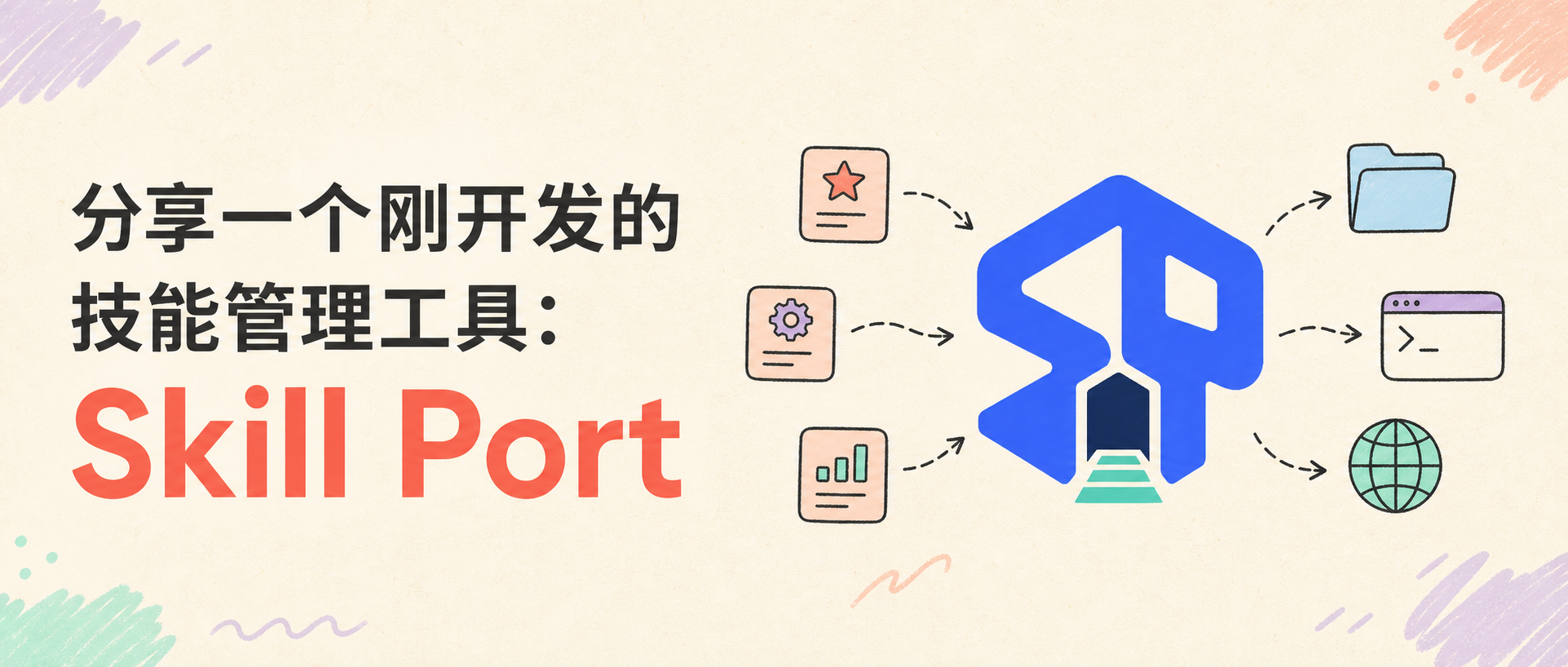
Store a Skill once. Skill Port uses a local Hub, explicit enablement, and source records, then serves multiple projects and agents through CLI and Desktop clients.
Developer tools, agent workflows, and engineering practice.
15 entries
Store a Skill once. Skill Port uses a local Hub, explicit enablement, and source records, then serves multiple projects and agents through CLI and Desktop clients.
A macOS menu-bar utility for several AI coding services. It surfaces the tightest available metric and lets one provider fail without blocking the others.
A public, self-contained Agent Skills library that packages content production, engineering governance, skill evolution, visual creation, and delivery workflows into reusable skills.
A journal-style agent that uses Markdown and a TypeScript CLI to preserve real life, with AI helping organize, ask follow-up questions, and review while the person keeps final judgment.
A public, chronological index for standalone research reports and interactive pages, deployed automatically through GitHub Pages.
A practice-first path for learning Pi: start with real work, add only repeated capabilities, and tune context after the workflow becomes familiar.
Turn a repository into an agent workspace so a fresh session can recover project facts, state, and the correct workflow from files alone.
Use observable acceptance criteria, risk-based tests, hard gates, and independent review to keep a fast Coding Agent on the intended path.
Break down the full agent cost chain, separate time gains from token billing, and choose tools and multi-agent collaboration by measurable cost.
A practical accounting of system prompts, repository context, tools, retries, and model routing shows where coding-agent costs really accumulate.
Use the repository to hold facts, process, state, and experience, then control agent risk with runnable slices, hard gates, and feedback loops.
Use executable prototypes, small runnable releases, stage gates, and observable feedback to constrain a fast coding agent.
A layered comparison of eight AI coding agents, covering architecture, engineering depth, enterprise requirements, and field-delivery scenarios.
Role boundaries and handoffs can make a multi-agent system legible, but context loss, semantic compression, and coordination cost often outweigh the apparent structure.
Move Obsidian notes into a structured wiki maintained by an LLM, with raw sources, a knowledge network, and explicit operating rules.
Try another keyword, or clear the filters to see everything.